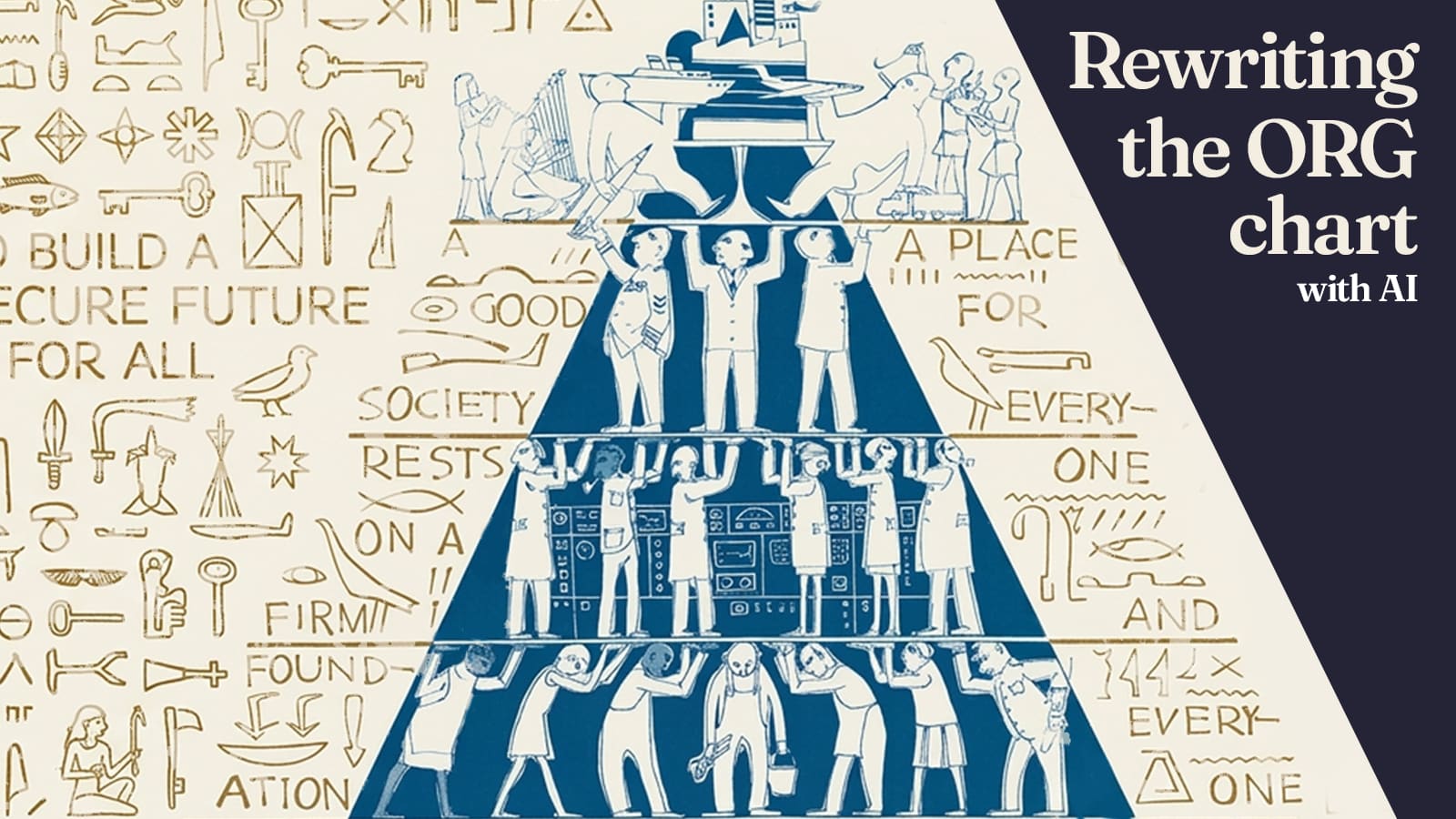
There’s a question that’s moved from the last ten minutes of a typical board meeting to top of the agenda in this last year: what ARE the job roles (billable or otherwise) of this new AI future? It surfaces as a hiring question, an agency-roster question, a services question, a SOW question, and an “is our marketing team the right shape” question. Underneath all of them sits the same thing: facilitating a funnel. In the creative and marketing industries we’re constantly evolving the scope, approach and ROI of the work we produce, driven by consumer intent, behaviours, opportunities, and appetite.
That’s the demand cycle, and since the ‘dawn of marketing’ it’s always moved. What’s newer is the pressure of capability underneath it: the servicing need. How the work gets staffed, commercialised, how it gets financed, and now how we evolve the creative services at the same speed as the work itself. In the last 6 months agents are increasingly doing a growing share of the making, planning, and routing of marketing and agency work - with generalist expertise (the ability to move between kinds of work rather than sitting in one lane) becoming the thing worth hiring, or training for. This piece is a commentary on that shift: building a base of experienced talent, and helping the talent already in the building combine for a newer way of working. To plan any of that, we’ll need a different unit of measure than the typical ‘job title’.
What’s a work archetype?
It’s not a JD in the traditional sense of the word, it’s a recurring pattern of ‘doing work’: tackling a set of tasks, or solving a type of problem. We like to think most of our jobs are unique, that “every day is different”, but the truth is, there are multiple predictable tasks and patterns in every job. You’re not special, sorry. This is the painful conversation about where those predictable patterns move to in an “AI ready” agency.
But let’s set aside the departments for a minute and look at the flow of future work. Job titles describe the org chart. Archetypes describe the process of handling the work. And AI agents are pulling those two things in different directions. Almost no agency job description written in 2020 featured the terms AI, agentic, or vibe coding. They ALL do now. It’s like saying you know MS Word or Photoshop! Table stakes graduates.
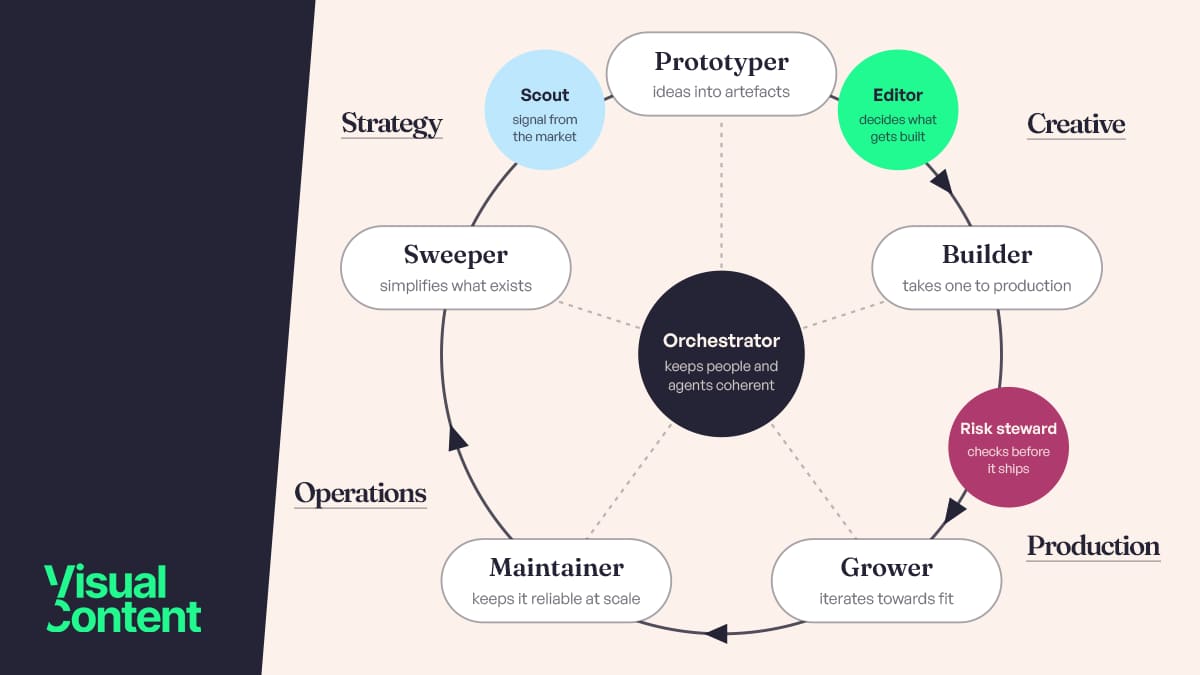
I was reading a framework from Boris Cherny, the creator of Claude Code, on what “formula” the new company might take in the future, from his perspective. Obviously this is fringe engineering behaviour, but it’s worth looking at with a cross-pattern-mapping head on. We are not gonna focus on industry or department here, we’re going to look at “the process of doing work” for any company. Boris commented on watching how his own team operates with agents handling most of the making, describing and shaping these into five patterns. The prototyper turns ideas into working artefacts fast, most of which never ship. The builder takes one of them to production grade. The sweeper simplifies and optimises what already exists. The grower iterates a built thing towards fit with its audience. The maintainer keeps a mature system reliable as it scales. His observation is that these were never really tied to job function anyway - across his team, designers, engineers and product people each split across them.
Sat around those five, in the client work I do, I keep meeting four more that face outwards. The “director”, who decides which prototypes deserve building. The “scout”, who gathers signal from the market. The “orchestrator”, who keeps a fleet of agents and people coherent. And the “risk analyst”, who looks downstream before anything ships (especially now that we are more actively sweeping through tech and production IT stacks).
None of these are a ‘job title’ per se, which is precisely why the framework travels so well with AI. You can apply this approach to the finance, content, marketing, sales, or ops teams and it STILL tracks. These archetypes are temperaments applied to the process of doing work, most people will span two or three (if you’re in a startup you’ll try to span five - but not well!). A sales team has its prototyper testing pitches and its maintainer sustaining the pipeline. A marketing team has its scout watching the audience shift and the creative team has its director deciding which ideas get scaled - and that’s where this article is going to focus. Us.
Mapping these archetypes to an agency (and marketing team)
Run a ‘typical agency week’ through those nine patterns and it’s striking how much of the mapping already exists under different team meetings and sprints. Planning and insight have always been scout work. The creative director’s call on which of thirty routes deserves the client’s money is “director” work, and it always was. The studio prototypes, production builds, the craft leads sweep, performance and CRM grow, brand guardianship maintains, and the producer running the traffic sheet is the orchestrator - increasingly of agents as well as people, and this is why it’s worth running this again. The agents.
An agency has always been a symbiotic system more than a stack of departments: each pattern only has value because of the rest of the team. A prototyper’s thirty routes are worth nothing without a director curating between them on behalf of a client, a scout’s signal only matters if a grower acts on it, and the risk analyst earns their keep precisely because everyone else is moving fast. What agents change is the tempo of that symbiosis rather than its shape: when the making layer speeds up tenfold, the judgement layer has to sit closer to it, deciding in days what it used to decide in quarterly reviews. The agencies and marketing teams handling this well are re-harmonising relationships they already had rather than bolting on an AI department - tightening the loop between scout and director, director and prototyper, so the whole system runs at the speed the making layer now allows.
What happens when you map a full creative team onto these archetypes?
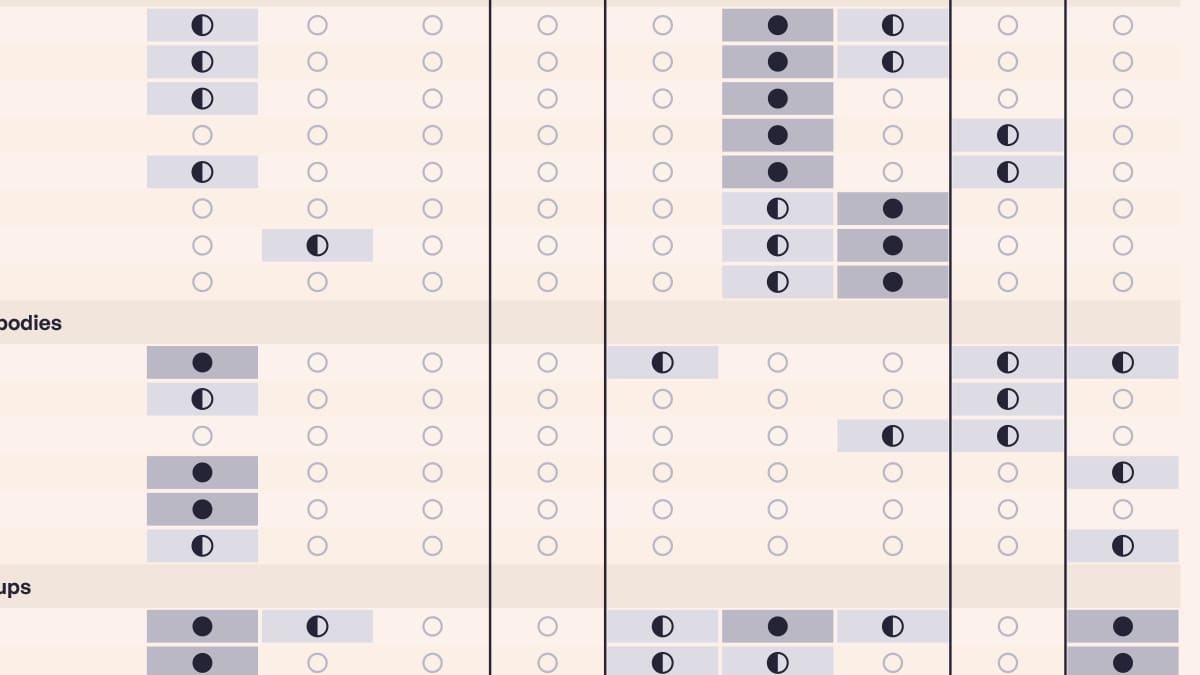
I’m in the middle of doing this mapping for real: taking the roughly 49 disciplines that make up a full creative and marketing team - everything from strategy and planning through design, motion, CGI, photography, copy, production, media and measurement - and mapping them onto this new archetypal order. And this isn’t job compression, it’s the exact opposite.
In its simplest form, we’re mapping the exposure to AI through each of the roles and defining how the service evolves with these skillsets. What is the next creative or commercial opportunity for this discipline?
The mechanical-execution part of almost every discipline will be subject to some form of automation; however the judgement part - does the work interpret the brand, is it original, does it capture the brief, does it fit the strategy - rarely is. So the useful bit becomes output-capability rather than input-skill. The old input-skill categories (“CGI artist”, “photographer”) blur as the ML and AI systems improve, while the thing a client is actually buying holds pretty steady.
Read it through Cherny’s lens, the making archetypes - prototyper, builder, sweeper - are all exposed, it’s the commoditising layer (cheaper and faster); the director, scout, orchestrator and risk analyst are the judgement layer that holds, and it holds in-house. And every exposure line carries a route with it - the augmented version of the role - so the map reads as capability and creative future lens rather than a redundancy line.
The second thing is where the leverage sits: in the brief. Across all of those disciplines the brief (and treatment) is where a job is won or lost, and it’s the point where expert human judgement carries the most leverage while being applied the least consistently. Whoever owns the brief owns the judgement layer, whatever agency their moleskin or job title says.
Let’s move this client side, and see how it maps onto a marketing team. Work enters the team differently when prototyping is nearly free - more of it arrives as a ‘made thing (POC)’ than as a written recommendation, so the director’s desk moves upstream. Mix modelling and ROI measurement, built for a world of quarterly campaign cycles, has to evolve when activity is essentially real-time: the model shifts from retrospective judge to live steering input, and attribution windows shrink towards the length of a working day.
And the target itself widens. Marketing success starts to mean designing for human-plus-agentic experiences - your buyers are using agents, so they will read your content before your buyer does (AI Search) - which is a far wider gamut than creating content and forcing it in front of eyeballs. The consumer archetypes are shifting underneath the discipline at the same time as the working archetypes shift inside it.
Does the evidence say roles will actually change?
Everything above is opinion formed in client rooms, so it’s worth saying the wider research reads the same way. When McKinsey Global Institute looked at agents and robotics in late 2025, its headline - around $2.9 trillion of annual US value by 2030 - came with a condition that will feel familiar to anyone whose services are already reshaping around consumer behaviour and new technology: the value only arrives where organisations redesign work around people and agents in partnership, rather than automating tasks inside structures that haven’t moved. That’s the demand cycle and the servicing need again, in research clothing.
And when KPMG and the University of Texas at Austin watched 1.4 million real workplace AI interactions, the people getting the most from AI were the ones treating it as a reasoning partner - framing, directing, feeding back - because they knew the job well. Those behaviours are observable, and teachable at scale.
For me that settles it: the archetype mix is a development and architecture question long before it’s a JD, corp structure, or recruitment, because the behaviours that separate the best operators can be taught to the people you already employ.
Where should an agency start with looking at this?
The tempting move is adding some ”…AI” to your hiring list, either as a line descriptor for each role or as a new job. The better move is much smaller: reading next quarter’s hiring plan as capability architecture. For each team or department you’re about to refine, ask which archetypes the team is actually short of, and whether the judgement those archetypes need already exists on the payroll. Some of what you were about to buy will turn out to be commodity building in six months (trust me) so contract in by the need. Some of it turns out to be directorial and insight-interpretation work worth bringing closer to the source, because it’s inseparable from your IP now, and in the future. Most workforce plans don’t need to be ripped up, just change shape: less buying in (staff, software, overheads), more combining - a base of talent & flexible stability in workflows, all helping drive towards a newer way of working.
When the “making” gets cheap, every department (and client) grows a maker. Finance, legal, marketing, operations - each will shortly contain someone prototyping what agent-enabled work looks like in their corner, whether or not anyone planned it. The archetypes arrive either way. The board-level question is whether you know who your directors, analysts and makers are, before the org chart or commercial performance dictates it.