
Personalised L&D content generation
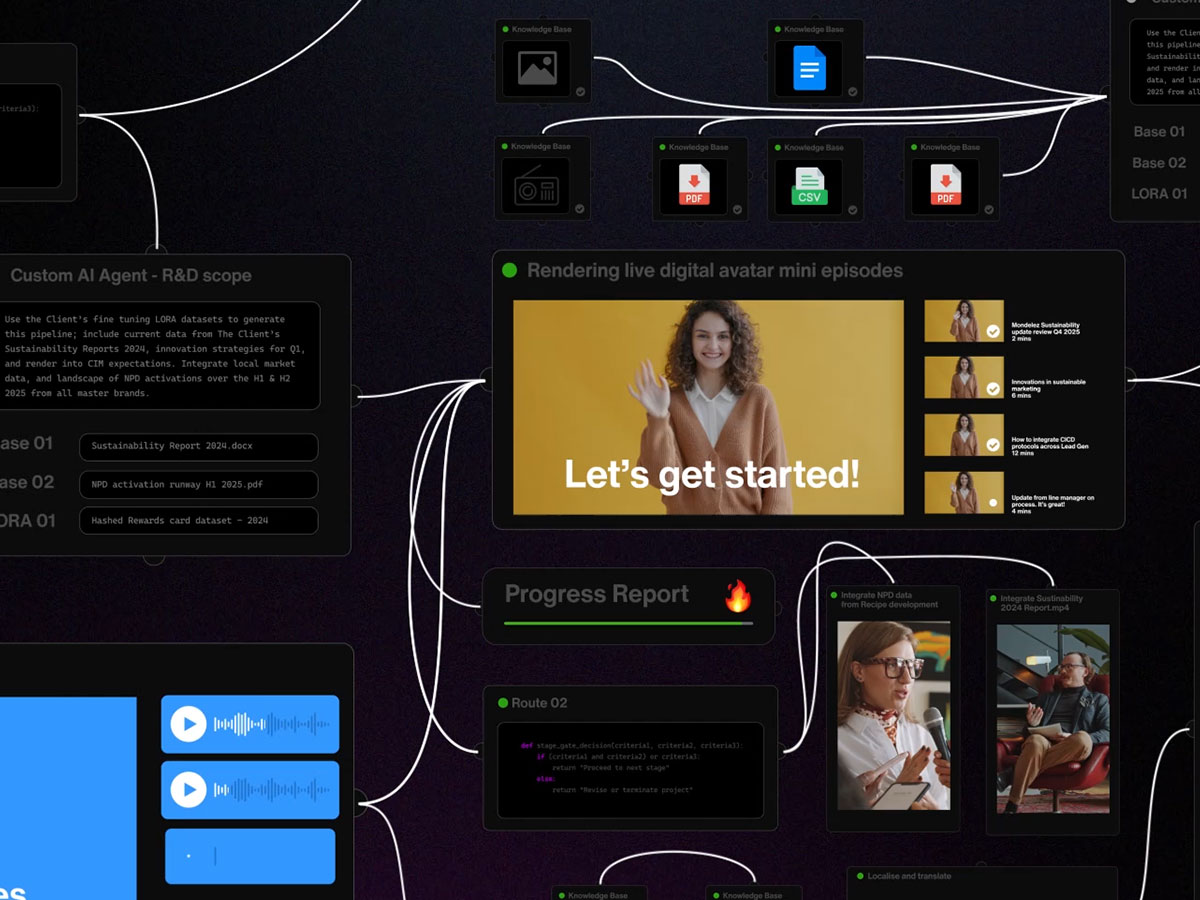
Designed a real-time L&D content framework for Mondelez that generates personalised, always-current rich media education content — delivered across any medium and tailored to individual learner preferences through digital avatars.
The challenge
What they needed
Mondelez's L&D team had the same problem I see across most enterprise learning functions: static content in a dynamic business. Their training material was built in traditional formats — decks, PDFs, the occasional video — and by the time it was signed off, distributed, and consumed, the operational context it described had already shifted. Product lines evolved, processes changed, market conditions moved on. The content was always slightly out of date, and the people consuming it knew it. The deeper issue was engagement. L&D content that looks and feels like compliance training gets treated like compliance training — people click through it as fast as they can to get the completion tick. Mondelez needed content that people actually wanted to engage with, that adapted to how different individuals learn, and that stayed current without requiring a full content production cycle every time something changed.
The approach
How I tackled it
Working through OxfordSM, I built a real-time framework for generating L&D content that stays perpetually current. The architecture is designed so that content updates itself as source material changes — rather than producing a course and then maintaining it, the system generates learning experiences on demand from live data and approved source material. The delivery model is medium-agnostic. The same underlying content framework can output as video, interactive modules, written guides, or audio — whatever suits the learner and the context. The personalisation layer uses digital avatars that adapt to individual learner preferences, creating a more engaging experience than generic corporate training. It's not a gimmick — the avatar layer is the translation mechanism that turns dry operational content into something people actually pay attention to.
Results
By the numbers
Content always current
Learner engagement uplift
Faster content updates
What was delivered
Outcomes
The Mondelez project is a good illustration of why I think enterprise L&D is one of the most underserved applications for AI. Most organisations treat training content like a publishing exercise — commission it, produce it, ship it, forget it until someone notices it’s wrong. That model made sense when content production was expensive and slow. It doesn’t make sense when AI can generate tailored learning experiences in real time.
What makes this framework different from a chatbot or a generic AI tutor is the production quality. “AI-generated learning content” usually means text-heavy, visually bland material that feels like a worse version of what a human would produce. The digital avatar layer changes that dynamic entirely. It’s a proper content experience — visual, personal, and engaging — that happens to be generated rather than hand-crafted. The distinction matters because L&D content only works if people actually use it.
The “always up-to-date” aspect is where the real operational value sits. In a business the size of Mondelez, keeping training content current across markets, product lines, and regulatory environments is a full-time job. Automating that currency — with proper governance over what feeds the content engine — removes one of the biggest friction points in enterprise learning.
- → Real-time L&D content framework that updates automatically as source material changes
- → Custom rich media education content that stays perpetually current
- → Multi-format delivery across video, interactive, written, and audio channels
- → Digital avatar personalisation tailored to individual learner preferences
- → Measurable improvement in learner engagement compared to static training content
Related thinking
From the journal
Designing for thinking: a framework for AI-augmented learning that doesn't make us worse
15 February 2026
The rush to summarise: what enterprise L&D loses when AI reads for us
8 February 2026
What should live in your head when AI remembers everything?
1 February 2026
Facing a similar challenge?
Every engagement starts with understanding where you are and where you want to be. No pitch deck required.